Showing posts with label prototyping. Show all posts

Friday, August 31, 2012

What unites us?

 . . . This is a question that has been on my mind over the last few months.  I'm part of a show going up this October with the theme 'E Pluribus Unum' (literally, 'Out of Many, One').  The exhibit is designed, in the words of curator Namon Bills:

"[The show] will be a response to the ultra-partisan nature of our country's current political climate. The concept is based on the United States' paradoxic situation as a unified whole composed of varying voices — the very embodiment of e pluribus unum: from many, one. America has always been an amalgamation of divided visions, dreams and opinions — even going back to the earliest days of our country's founding. America's success comes not from all of our citizens looking and thinking alike, but from our rich diversity of experience, background and opinion, combined with a willingness to talk to, listen to, and work with those that we disagree with. This country was founded on a willingness to set aside individual differences and compromise for the good of the whole."

It is not-so-coincedentally timed right at the elections.

In preparation I read and watched the John Adams book and miniseries as well as Naomi Wolf's 'The End of America: Letters of Warning to a Young Patriot".  Nice bookends on the American experience.

One of the things that struck me about the history of our country is the repeated emergence of 'The Other'; a common foe or challenge that unites us (the British, the French, the Loyalists, terrorism, etc).  Although I'm no historian, it seems as though when we don't have an external foe we turn on a facet of our selves (Republicans, Democrats, the Tea Party, snowboarders . . .).

I'm all for keeping each other accountable, but what happened to recognizing The Other as a concept that pushes us to our better selves, rather than an enemy to be defeated?  I think tennis is a good metaphor: neither opponent can play by themselves, and the best athletes recognize that their success depends on their competitors.  Although I'm no fan of Lance Armstrong, his battles with Jan Ullrich during the Tours of the early 2000's exemplified this spirit.  Of course politics and armed conflicts have much higher consequences than Wimbledon and the Tour de France, and sometimes the Enemy/Other must be dealt with accordingly.

I think it is the compressing of the spectrum of The Other to a single concept that is particularly dangerous.  It is becoming harder and harder to distinguish who is our metaphorical tennis opponents and who should be under surveilance or on the Predator drone short list.  

Specifically I wanted to depict artists who questioned their context and were imprisoned for it.  I also wanted to try my hand at stencils by using them to create layers of patina on metal plates (rather than the 'traditional' spray paint masking a la Banksy):

The following images are spray paint and rust tests that will inform the final plates:

Aleksander Solzhenitsyn was a Russian writer born around WWI who was sentenced to 8 years in a labor camp for his criticisms of Stalin.  
Rust patina test on mild steel sheet

spray paint test on cardboard

patina test on mild steel

Ai Weiwei is a contemporary Chinese artist who has been particularly outspoken about the human rights abuses and 'democracy' of China.  He was arrested and his studio demolished.  He is also the subject of a recent documentary Never Sorry.
spray paint test

Henry David Thoreau was an American writer in the 1800's who was arrested for refusing to pay taxes that would support slavery.
spray paint test on cardboard

Tim DeChristopher is an activist who I categorize as a 'performance artist' (although he may not) who intentionally disrupted illegal federal land lease auctions in Utah by posing as a legitimate bidder.  He is currently serving a prison sentence.
spray paint test on scrap cardboard (I like how the bar code ended up on his forehead -- unintentional Warhol-esque commentary on the commodification of protest?)

Thursday, April 19, 2012

Great Basin National Park table models

As part of my 2011 Artist-In-Residency at the Great Basin National Park, I agreed to produce and donate a piece of work that was inspired by my time there.  I've been making some small-scale models of a larger sculptural table (that I'll bring out in a month or so) to explore different ideas before committing to the full-scale work.

I'm playing around with the geometries I experienced in the Great Basin:  the curves and swoops of the Bristlecone pine trees high on the exposed ridges, and the orthogonal lines and grids (farmland and road, for example) that were apparent from the air and on maps.


Thursday, July 7, 2011

Digital Sketchbooks

I have kept idea logs and sketchbooks since high school; for me it has been one of the most important aspects of generating, organizing, and embodying artwork over the years.  The value of keeping a sketchbook certainly isn't limited to the visual arts, it can make the difference in any organization that depends on consistently generating great ideas.  I used to work with the folks at Jump Associates, and they were (and are) masters of generating great ideas about everything from toy guns that spark to flesh-colored Christs that glow in the dark.  Take a look at their 'Ten Habits of Great Ideators"(http://www.jumpassociates.com/ten-habits-of-great-ideators.html) to see what I mean.

Specifically, lets talk about Habit #7: keeping an idea log.  One of my main problems has always been using sketchbooks as reference material days or years after drawing the original idea -- they are created chronologically and therefore organized as such, which isn't very useful if I'd like to see all of my ideas about chairs or kinetic sculpture -- there may be 100 ideas about each but spread throughout 20 years of sketchbooks.

I used the Rollabind system (http://www.rollabind.com/) for a while, although ideas could still only be categorized by one attribute (I could have a binder for chair ideas, but what if I wanted to see all of my thoughts on chairs AND recycled materials?  Or Europe AND steel AND beer?).  What I needed was a way to tag each sketch much like we tag photos on-line . . . these tools allow you to search for photos of yourself: yourself and Bob; yourself, Bob, and Sammie; etc.

So, enter iPad, Penultimate, and Tagit, my next foray into idea organization.  The iPad is like a big cell phone, minus the phone part and plus a huge touch screen and nerd cred.  Penultimate is a drawing application on the iPad.  (So far, so good -- I've just replaced $5 of notebook and pencil with $650 of delicate electronics that does the same thing, only not as well)  The value comes with using Tagit, another application that applies multiple labels to files on a computer, so you can search for multiple attributes at once.

My process goes like this.
Step 1: Pull out iPad and sketch ideas using Penultimate software.  Bonus points if client is present and impressed with tech savvy.

Step 2:  Email myself a pdf of the sketch idea from the iPad, which is then filtered by the mail program into a folder labelled 'Brilliant Ideas'.

Step 3:  Weekly (translation: yearly) use Tagit software on home computer to retrieve sketches from email and tag them with appropriate labels.  Pat self on back for thinking about 'metadata'.

Step 4:  Use Tagit to search sketches when I need to find ideas on Tables + Car Parts + Elmo Impersonators.


The value of this system increases with each file; its not that useful when there are only 5 sketches, but with 50,000 it certainly helps.  In addition, multiple types of files can be tagged: audio, web pages, images, word docs, etc.  I've even heard of people doing away entirely with the folder hierarchy on their computers and only tagging files.

My biggest issue so far is the number of steps.  How about being able to tag the penultimate pages as they are created, like the way we do blog entries?  I plan on emailing this idea to the creators of Penultimate right after I email it to myself and tag it Ideas, Frustration, GettingOnMyHighHorse, and Sketchbook.

Thursday, March 24, 2011

Alcohol in Utah: a grant proposal

The following is an excerpt from a recent grant proposal I submitted-- although it hasn't been fabricated or approved (yet), I hope it will help inspire some mature dialog about the role of alcohol in society.  The request was made by Utah's Department of Alcoholic Beverage Control (DABC), which owns and operates all of the liquor stores in the state.  For those unfamiliar with the Promised Land, think of it like going to the DMV to get a bottle of wine.


4 views of the proposed sculpture


Summary
The DABC has the wonderful opportunity to support the arts and establish a distinct visual presence at its new stores across the state.  I propose to build a permanent outdoor sculpture of steel and concrete that depicts the plants from which beer, wine, and spirits are made.

The Site
If Utahns are anything, they are connected to their land.  Many of our traditions and livelihood depend directly upon it.  In fact, just blocks away from the Holladay Liquor Store there are community gardens and horse pastures.  Even our license plates show the rocks and the weather that make Utah a world famous destination.  Without the natural ecosystems of Utah and the land that support them, we would literally loose our sense of place.

I think it would be interesting to show the link between the land and the things that the DABC sells.  Many of the plants from which beer, wine, and spirits are made are grown in Utah; we have our own vineyards and breweries which are familiar to the store’s patrons.  Although I’ve presented this sculpture in the context of the Holladay store, will work thematically and visually with any of the other sites available should they be found to be more appropriate venues.
Sculpture on-site at one of the liquor stores

The Sculpture
In this proposal I include conceptual images of a sculpture placed on the Holladay store grounds.  It will be approximately 4 feet wide by 4 feet deep and 7 feet tall.

It is comprised of a square concrete base on top of which are permanently mounted four steel panels forming an enclosed box.  Cut out of each panel are depictions of specific plants that are key ingredients for some of the products sold in the Liquor Store.  For example, barley and hops are crucial in the beer making process and are aesthetically powerful images when rendered out of the steel plates.  In addition, the names of the plants will be inscribed on the concrete base.

The design of the sculpture is such that maintenance will be kept to a minimum.  The steel will develop a deep red rust patina and is of a gauge thick enough that the metal will not be structurally compromised.  The concrete base will also be reinforced and treated to avoid cracking and deterioration.

Friday, December 3, 2010

The Canyon Table -- Part 2


I try to prototype like I vote – early and often.  The sooner I can see what the materials/volumes/finishes are going to do, the better design decisions I can make.

The Canyon Table will have a map of the topography formed by the Green and Colorado Rivers.  It is a location that is important to me, as well as a metaphor for our journeys through life, their twists, and confluences with others.

3D modeling programs have their place, and as an artist I find them useful for a quick, inexpensive gut check as to sizes and shapes that might work well.  Google Sketchup is intuitive and has a ton of on-line support.  After that stage, I have yet to find a good replacement for actually trying scraps of the material I will use.


Friday, October 15, 2010

The Ambiguous Family, Part 6

Prototypes of connection methods and cutting techniques from a donor  truck hood.


Connections and edge treatments are important.  I realized I don’t have enough information or experience with different concepts of alternative families to make a good artistic decision on what method to use to attach the truck hoods to the structure.


I plan to interview and visit a few folks in the next several weeks and hopefully that will help give me some resolution about how to continue.


Friday, August 27, 2010

The Ambiguous Family, part 2


What raw material is better to depict families under siege than wrecked truck hoods?  One of my favorite locations for sculptural ideas is the local wrecking yard. 

Specifically, older truck hoods are the best to use – they are bigger than those on cars, tend to be flatter (and yield more ‘blank canvas’, so to speak), have less complicated structural reinforcement to work around, and with a little looking you can find ones that have wonderful rust patterns on them. 

I also recommend a trip to the junk yard for anyone debating a car purchase – the vast majority of vehicles there were from Detroit’s drawing boards.  It may be that GM, Ford & Chrysler are overrepresented in the cars on the road (and thus in the junkyards as well), but my own experience owning several says they were intended to last the life of the loan and that’s it.  But, hats off to them for providing raw material for our artistic foolishness.

In contrast, cardboard makes a difficult prototyping material for sculptures this size.  I felt a little guilty for stealing it from the recycling bins, but then again, maybe I’m just participating in re-recycling.


Friday, August 20, 2010

Ammo Table, part 4


The search and procurement of empty ammunition casings has proven to be as interesting, if not more, than actually making this table.  So far I’ve been involved with the local police department, several shooting ranges, and friends and family with an interest in (or job that requires) guns.  The folks at “Get Some Guns & Ammo” (no, seriously) have been particularly helpful. 

As a side-note, I recently met a wonderful Australian couple deep inside Canyonlands National Park, and one of the things they wanted to do while in the States (besides exploring Canyonlands and climbing around the Rockies) was to shoot assault rifles.  I’m not sure if that statement said more about their sense of adventure or more about the perception of the American West – probably a bit of both.

The table structure and subsurface is near completion, and I’ve done a few smaller prototypes to make sure the effect will be striking enough.


And another image that I think might be particularly striking and invite some animated discussion:

Friday, July 30, 2010

The Ambiguous Family, Part 1

I recently saw 8: The Mormon Proposition and got to thinking about families.  The documentary outlines the Mormon church’s financial and interpersonal mobilization to pass Proposition 8 in California restricting marriage to a man and a woman.

For ten years I taught at various levels from middle school through college, and interacted with hundreds of families.  I’ve seen both successful and utterly dysfunctional traditional families (one mom, one dad, a few kids).  I’ve also seen both very healthy and unhealthy non-traditional families (one mom and a child, or two dads, or a mom and a grandparent, etc).

I certainly don’t know how to measure the success of a family unit, but I can tell it has more to do with the relationship between its members than what gender or age they are.

So, the idea of doing a sculpture that represents a family with ambiguous gender roles was an interesting one.  I especially like the sculptor Cordell Taylor, and was thinking of using a visual vocabulary similar to his use of raw steel and abstracted geometrical shapes.  In it I want to show the family in a posture of protection, like a group of elephants circling their young during an attack.

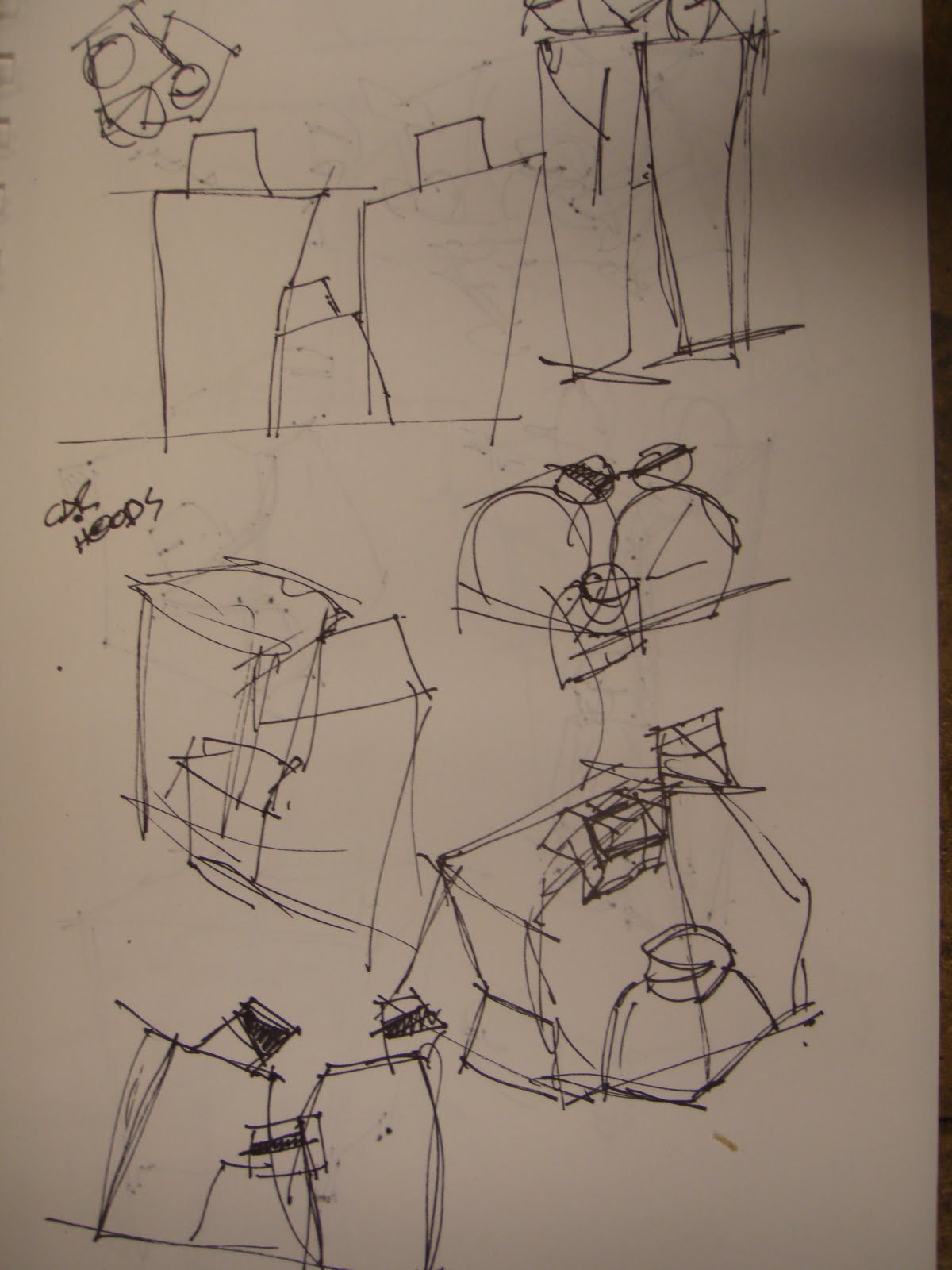
Some original sketches:


And a few models to get a feeling for the weight and three-dimensional flow.  I personally am leaning toward the tall angular one; it reminds me of the rock art in southern Utah.

Now, to figure out the final material to use.  I’d like it to repurpose something rather than use new concrete or steel or wood.


Cordell Taylor

8: The Mormon Proposition

Friday, July 23, 2010

Ammo Table, Part 3

Now that the search is underway and I’m gradually gathering these casings, I’ve found I should start figuring out what on earth I’m going to do with them when I get several thousand of the little suckers.  I’ve tried to approach prototyping my art like I approach voting -- do it early and often.

While fondling some of the casings (why is it everyone edges away from my table at the coffeehouse when I do this?) I realized that the open end and the closed end are two very different colors -- the shadow of the open end is dark, even when viewed outside, and the closed end is reflective.  Now I’ve got a direction -- I plan to arrange the casings open-end or closed-end up so that the resulting pattern depicts a portrait, kind of like if you zoom in on a digital black-and-white photograph.  At some great magnification, all you see is black or white pixels.  

Who would be an appropriate subject for a portrait out of spent ammunition?  Martin Luther King, Charles Taylor, and JFK all seem a little too trite and obvious.  Mickey Mouse?  The McDonald’s logo?  Here are a few ides, pixelated to the approximate degree they would be on the table.


Several years ago I did a series of sketches on Humphrey Bogart, and was fascinated with his eyes in particular.  Here are some that have potential for the table design.

Since pixelated computer graphics only have a small resemblance to bullets, I decided to prototype the image again, this time by drilling holes (representing the open-end-up shells) into a board with the graphic of Bogart’s eyes.