Showing posts with label controversy. Show all posts

Friday, November 30, 2012

Ai Weiwei: Never Sorry


The dreary weather gave me a chance to see a film I've wanted to catch for a long time: Ai Weiwei: Never Sorry.

Ai Weiwei is a Chinese artist who has been pretty outspoken about the human rights abuses in China, one notable example being his work to uncover the shoddy school construction that led to many deaths from the 2008 Sichuan earthquake.  He also worked on the famous Bird's Nest stadium for the Olympics (which he later boycotted) and installed an exhibit at the Tate using one hundred million hand-painted sunflower seeds (yes, thats One Hundred.  Million.)

Not surprisingly, he was detained by the Chinese government for three months on charges of 'tax evasion'.  I've depicted him in a couple of my works: both 'The Others' in the E Pluibus Unum show and as part of an installation highlighting imprisoned artists.

The trailer from YouTube:


It you're on the east coast, you can see his work in person at the Hirshorn.
Radio West recently interviewed the filmmmaker as well.


http://www.hirshhorn.si.edu/collection/home/#collection=ai-weiwei-according-to-what
http://radiowest.kuer.org/post/ai-weiweis-art-dissent
http://www.guardian.co.uk/artanddesign/2010/oct/11/tate-modern-sunflower-seeds-review
http://en.wikipedia.org/wiki/Sichuan_schools_corruption_scandal
http://www.youtube.com/watch?v=2dtfeh6a01c
http://www.imdb.com/title/tt1845773/


Wednesday, October 10, 2012

The Other

As part of the E Pluribus Unum show I'll be doing two works, one on my own and one as a collaboration with Chad Crane.  My solo work is titled 'Others: Thoreau, Weiwei, DeChristopher, Solzhenitsyn'.  It is made of a sheet of steel with a welded frame; the images are made by oxidizing the metal at different rates with different chemicals.


The basic idea of the show was to investigate what unites us as a country.  I think part of the answer lies in having an 'other' to unite against.  The catch is that we have a history of demonizing people and movements that hold up a mirror which would have inspired us to our better selves, if we didn't throw these folks in jail.

Specifically, the four individuals in my work were all put in prison for their efforts: Thoreau refused to pay taxes that funded slavery and Solzhenitsyn criticized Stalin.  The last two are our contemporaries; Ai Weiwei is critical of the human rights abuses of the Chinese government and DeChristopher disrupted illegal land auctions to oil and gas companies.  The thought process I've described here, along with the theme of the show.


https://www.facebook.com/epuartshow

http://chadcrane.blogspot.com/2011/01/familiar-territory-art-access-september.html

http://blueboathome.blogspot.com/2012/08/what-unites-us.html

http://en.wikipedia.org/wiki/Civil_Disobedience_(Thoreau)

http://en.wikipedia.org/wiki/Aleksandr_Solzhenitsyn

http://aiweiweineversorry.com/

http://www.bidder70.org/

Friday, August 31, 2012

What unites us?

 . . . This is a question that has been on my mind over the last few months.  I'm part of a show going up this October with the theme 'E Pluribus Unum' (literally, 'Out of Many, One').  The exhibit is designed, in the words of curator Namon Bills:

"[The show] will be a response to the ultra-partisan nature of our country's current political climate. The concept is based on the United States' paradoxic situation as a unified whole composed of varying voices — the very embodiment of e pluribus unum: from many, one. America has always been an amalgamation of divided visions, dreams and opinions — even going back to the earliest days of our country's founding. America's success comes not from all of our citizens looking and thinking alike, but from our rich diversity of experience, background and opinion, combined with a willingness to talk to, listen to, and work with those that we disagree with. This country was founded on a willingness to set aside individual differences and compromise for the good of the whole."

It is not-so-coincedentally timed right at the elections.

In preparation I read and watched the John Adams book and miniseries as well as Naomi Wolf's 'The End of America: Letters of Warning to a Young Patriot".  Nice bookends on the American experience.

One of the things that struck me about the history of our country is the repeated emergence of 'The Other'; a common foe or challenge that unites us (the British, the French, the Loyalists, terrorism, etc).  Although I'm no historian, it seems as though when we don't have an external foe we turn on a facet of our selves (Republicans, Democrats, the Tea Party, snowboarders . . .).

I'm all for keeping each other accountable, but what happened to recognizing The Other as a concept that pushes us to our better selves, rather than an enemy to be defeated?  I think tennis is a good metaphor: neither opponent can play by themselves, and the best athletes recognize that their success depends on their competitors.  Although I'm no fan of Lance Armstrong, his battles with Jan Ullrich during the Tours of the early 2000's exemplified this spirit.  Of course politics and armed conflicts have much higher consequences than Wimbledon and the Tour de France, and sometimes the Enemy/Other must be dealt with accordingly.

I think it is the compressing of the spectrum of The Other to a single concept that is particularly dangerous.  It is becoming harder and harder to distinguish who is our metaphorical tennis opponents and who should be under surveilance or on the Predator drone short list.  

Specifically I wanted to depict artists who questioned their context and were imprisoned for it.  I also wanted to try my hand at stencils by using them to create layers of patina on metal plates (rather than the 'traditional' spray paint masking a la Banksy):

The following images are spray paint and rust tests that will inform the final plates:

Aleksander Solzhenitsyn was a Russian writer born around WWI who was sentenced to 8 years in a labor camp for his criticisms of Stalin.  
Rust patina test on mild steel sheet

spray paint test on cardboard

patina test on mild steel

Ai Weiwei is a contemporary Chinese artist who has been particularly outspoken about the human rights abuses and 'democracy' of China.  He was arrested and his studio demolished.  He is also the subject of a recent documentary Never Sorry.
spray paint test

Henry David Thoreau was an American writer in the 1800's who was arrested for refusing to pay taxes that would support slavery.
spray paint test on cardboard

Tim DeChristopher is an activist who I categorize as a 'performance artist' (although he may not) who intentionally disrupted illegal federal land lease auctions in Utah by posing as a legitimate bidder.  He is currently serving a prison sentence.
spray paint test on scrap cardboard (I like how the bar code ended up on his forehead -- unintentional Warhol-esque commentary on the commodification of protest?)

Wednesday, October 5, 2011

The Organic Grid

Many parts of Nevada are big and open, and there are lots of signs that say things like 'Get gas now! No services 15,200 miles'.

The need to understand the landscape here goes far beyond a passing cerebral appreciation for the flora and fauna; you could run out of gas and water and have your eye sockets pecked out and tires stolen by vultures before the next truck comes along. Take a look at the fantastic account of the Donner party's 'cut-off' route through the east end of the Great Basin in 'Trial by Hunger' for an idea of what I mean. (To summarize: ignorance of Great Basin geography means snacking on each other's femurs by winter.)

"The making of such a map is an interesting process . . . fixing on a small sheet the results of laborious travel over waste regions, and giving to them an enduring place on the world's surface."
-- John Fremont, explorer of the Great Basin, mid 1800's

In William Fox's book 'Mapping the Empty: Eight Artists and Nevada', he addresses 'one of the oldest dichotomies in history, the tension between the organic shape of the natural world and the mathematical grid'. In the American West this can be charted beginning with Fremont's original maps of the area to Google Earth's view of straight roads bisecting and bending around landforms in the basin and range. Artists like Andy Goldsworthy have taken a different approach by constructing things out of the natural world that have some innate geometry to them that wasn't there before.

I think we should be very wary trusting current culture with our experience of anything, especially when it comes to that weirdo art crowd. Unfortunately we can't all be out all the time seeing all of this amazing stuff for ourselves, and need to trust something to show it to us, or at least tell us how we can make money from it. Catherine Norman (yes, we are related) in her thesis on Goldsworthy's earthworks notes that:

" . . . we can see a prevalence of the preconceived image of nature: a postcard of the Grand Canyon, perhaps, some view of sweeping land that our society claims is beautiful . . . interstate highways alert us with signs when we need to pull over for a scenic view. Culture has become in this way the mediator of nature, controlling our views of landscape and detaching us from actual experience with nature"

Land and life are intertwined -- we've relied upon it for sustenance and safety for millions of years, and it is only recently that we have put so many intermediaries between us that, unless you are one of the lucky few, it is outside our experience. The mediators we use can intentionally or otherwise put the human geometry on landscapes: often times photography and writing are the principle culprits. Historically, this translated experience has run the gamut of intended effect from its authors: over the last three hundred years alone the American West has been symbolized as the playground of the devil (early Puritan settlers), the divine (Muir, Thoreau), an adversary to be overcome (Remington, Hemmingway), a co-author in the human experience (Goldsworthy, Wright), and an entity possessing of it own value and rights (Adams, O'Keefe).

In rural Nevada it is impossible not to have some aspect of nature impact daily life. The consequences of ignorance usually aren't cannibalistic in the Donner-Party-Lets-Have-Hank-As-The-Appetizer sort of way, but dire nonetheless. Many of the professions out here depend on nature: ranching, farming, tourism and mining to name a few. The problem is that nature doesn't use the precise boundaries and words that we like to use, so we have to figure out how to translate between the wilderness and our needs. The town of Baker, NV, just outside Great Basin National Park is a case study in the 'tension between the organic shape of the natural world and the mathematical grid'.

To wit: the US Postal service is facing the need to cut costs, and proposes to do so by eliminating select rural post offices like the one in Baker, as well as the one in Garrison, UT, 10 miles away. That would mean that residents, some who rely on mail for medications and critical ranch supplies would have to drive 60 miles over two mountain passes to Ely, NV. Why not just consolidate the two post offices instead of eliminating both? Well, there happens to be a state line between them. Each post office is in a different administrative district, apparently neither of which is aware the other exists and coordination between the two is difficult at best. The imaginary, arbitrary, and very straight line down the middle of the Snake Valley separating Utah from Nevada seems not only not useful but it actively undermines the welfare of residents on both sides of it. (Yet at my house in Salt Lake the USPS dutifully delivers ads for plasma screen TV's 6 days a week to my front door, and there are 4 post offices within 10 miles).

We can't talk about abstract geometric boundaries and people without addressing water rights. Underground aquifers are like the US Olympic Hockey team: we all share them whether we like it or not, and our life depends on their health. My grandfather was a lifelong rancher in Waco, TX and I have clear memories of lively kitchen table discussions about water issues: who's got it, who wants it, who's wrecking it, and who's stealing it.

In this chunk of Nevada, the Southern Nevada Water Authority has been buying ranches in Spring Valley on the west side of the National Park and planning to tap the aquifer to supply Las Vegas with more golf courses and heart-shaped swimming pools 200 miles to the south. Yet this aquifer, like all good nature, doesn't care about property lines. It is intimately related to the ecosystem of GBNP as well as the water in the neighboring valleys which is critical to the farmers, ranchers, and anything else alive there.  (The question of Las Vegas creating more swimming pools and golf courses is another discussion altogether, one I think would be solved most expeditiously by relocating the Nevada Nuclear Test Range into the lobby of the Luxor Casino. But I digress.)

The solution lies, I think, in how Fremont originally mapped and named the Great Basin. He describes its boundaries hydrologically, not politico-geographically. ("[the area] containing many lakes . . . with their own system of rivers and creeks, and which have no connection with the ocean or the great rivers which flow into it.") In addition, William Fox noted that:

"Just as each audience in the East [in the late 1800's] had its own distinct uses for the art of the great western expeditions -- from scientists requiring accuracy to developers seeking the reassuringly picturesque -- so the artists produced works in response to those needs."

Not that all of our state and county boundaries should be altered to reflect aquifers or even communities of people, but perhaps those nutty artists in our midst can use the 'organic shape of the natural world' to provide a better future for the American West.

Wednesday, May 4, 2011

The Ambiguous Family, completed

This sculpture represents a family.
               
The idea for this sculpture started with my involvement with the gay rights movement here in Utah and the legislation that attempted to define what a ‘family’ was and was not.  Specifically, I wanted to represent a group with ambiguous genders in a defensive posture.  What better way to demonstrate a family under siege than to use a material that has been battered, worn, and discarded . . . like hoods from wrecked trucks?

The fascinating thing about this project is that the more I talked to people about it, the more I saw how everyone on both sides of this issue felt like their concept of family was being attacked.  How interesting is it that we’re all at each others’ throats even when we have the same basic joys and fears?


To see the process of creating this sculpture, look here:


Part 1, Part 2, Part 3, Part 4, Part 5, Part 6, Part 7


This sculpture is part of the Lawn Gnomes Eat Your Hearts Out exhibit through the Salt Lake Art Center.  See more information about bus, bike, and walking tours here:


http://www.slartcenter.org/?page_id=249

 . . . and a Google map of all the sculptures across SLC here:

http://maps.google.com/maps/ms?hl=en&ie=UTF8&msa=0&msid=202526600326316503418.0004a13b990f61e4bf3c8&ll=40.665535,-111.868286&spn=0.250003,0.439453&z=11&source=embed

To hear the artists talk about their work, call 801-349-3498 and enter the number of the sculpture (the Ambiguous Family is 212).  Each sculpture has a sign by it explaining this process.


Friday, April 29, 2011

Pecha-Kucha: Inspire Japan

I recently gave a presentation at Pecha-Kucha Night here in Salt Lake.  (For a description of Pecha-Kucha, see here.)

The basic idea is to give designers and creative types 20 seconds for each of 20 slides, spreading great ideas and avoiding windbags.  Since the concept started in Japan, this particular event was a fundraiser for relief efforts there.

My presentation can be found here.  The video is a little hard to see at times, so I've included the slides below.  Enjoy!


http://www.pecha-kucha.org/

http://vimeo.com/22924704

Friday, March 11, 2011

Exit Through the Gift Shop


From IMDB:


The story of how an eccentric French shop keeper and amateur film maker attempted to locate and befriend Banksy, only to have the artist turn the camera back on its owner. The film contains footage of Banksy, Shephard Fairey, Invader and many of the world's most infamous graffiti artists at work. 


What if this film isn’t a documentary?  I tend to fall on the side of those who believe the character Mr. Brainwash (although he actually exists, and his shows actually happened) was a creation for the film, Spinal-Tap style. 


What would be a better way to comment on the ridiculousness that is the modern art scene than to fabricate an artist?  Banksy has done this sort of performance/art before, specifically placing fake (and in my opinion more engaging) art in famous museums alongside the legitimate works on display.


Mr. Brainwash’s art is so redundant of other famous modern artists’ work (Warhol, Basquiat, Fairey, and Banksy himself) that to create him as a legitimate artist with a body of work, shows, and actual sales is the ultimate prank on the contemporary art establishment and its love affair with street art.


I’m not the first person to have this opinion, but I think it does make the film much more interesting.  Too bad it narrowly missed an Oscar for  Best Documentary.

Thursday, March 3, 2011

The Court of Public Opinion


'The Court of Public Opinion' 


I’ve become more and more convinced (and more and more hopeful that I’m wrong) that we can get people to do anything if we throw enough fear or money at them.  Campaign finance reform, though it doesn't sound particularly exciting, is a crucial application of this dynamic.

There is certainly a correlation (although the direction of causation may be in question) between the amount of money spent on a presidential campaign and the likelihood of a candidate winning.  NPR found that:

In presidential primaries, money is usually the sign of a winner. Since 1980, the best-financed candidate has won eight out of the 10 contested primaries.

My intuition says that more money means more media presence, hence more people convinced to vote for that candidate.  Or, it may be that winners are a sign of money.  Steven Levitt, the author of Freakonomics, has a fascinating rebuttal of NPR's line of thinking.   I’m not sure that it can be extrapolated to the office of the presidency, though; the race to the POTUS seems to have many more dynamics at play.  How else could we explain that a corrupt dimwit from almost-Russia was a viable threat in the polls to a president of the Harvard Law Review?

Despite the direction of causality, the role money plays in a democracy is an important and potentially problematic one.  


Monday, February 28, 2011

Signs of protest

I'm really liking the design of the '70' protest signs in support of Tim DeChristopher (see www.bidder70.org or http://www.peacefuluprising.org/climate-trial).

Simple, elegant, and repeatable.

Friday, October 8, 2010

The Ambiguous Family, part 5

While working on this sculpture over the past week, the issue of gay marriage and the question of biological determinance of homosexuality have been in the local and national news.

Boyd Packard, one of the highest-ranking Mormon church leaders, condemned same-sex marriage and insisted that same-sex attraction is a lifestyle that can be changed through prayer.  Previously, Packer had authored a pamphlet that advocated violence against gay people .  Many have criticized the LDS church’s stance on homosexuality as a contributing factor to Utah’s disproportionate rate of gay teen suicides.
Protest outside the gargantuan LDS office buildings


4500 people were estimated to attend the protest

I traveled to a silent protest orchestrated several days later in response to the LDS position on gay rights.  It struck me how many of the participants were youth from the community; my previous experience attending rallies and protests had relatively few youth participating.

In national news, the Supreme Court is also hearing a case that pits free speech against privacy in a case involving anti-gay protestors at the funeral of an American soldier killed in Iraq.

What, exactly, does all this have to do with a hunk of welded steel taking shape in my shop?  I’ve found that while working on any project I’m making thousands of decisions every minute.  Just a single brush stroke on the finish of a piece involves considering the type of brush, its angle, pressure, length, etc.  So, the decisions that surround actually fabricating sculpture multiply exponentially.

7 ft sculpture structure awaiting its skin of reclaimed pickup truck hoods
One of the larger decisions I’ve facing now deal with methods of attaching the plates of metal from the truck hoods onto the skeletal structure of the piece.  Welding, riveting, bolts – each method imparts a different visual language and emotional impact on the folks looking at the sculpture.  All of the recent news makes me lean toward attaching the plates in a way that stresses the defensive posture non-traditional families under attack have to take to protect themselves and their children.  

Friday, October 1, 2010

The Ambiguous Family, part 4


While continuing work on the Ambiguous Family sculpture, I had NPR on in my shop.  Completely serendipitously, the program was “The End of the Macho Man?”  on Talk of the Nation.  Neal Conan was interviewing Guy Garcia  and Hanna Rosin , two authors who have written about the changing role of men.  The basic consensus was that jobs often held by men are disappearing (manufacturing heading overseas, for example) and jobs traditionally held by women are increasing (nursing and teaching).  This labor shift, along with data showing that more women are enrolled in higher education than men, portends a shift in men’s roles in society.  That shift means that the provider and protector roles that men have traditionally had, and had been modeled by their fathers and grandfathers, will need to be met in other ways now that many men are unemployed or will shift to ‘unmanly’ jobs.

It got me to wondering if the arguments against gay marriage and hostility towards gay couples are fueled by a societal fear of the changing role of men.  It seems that two men having a family would be a very obvious lightning rod for latent angst over job, direction, and gender role loss.  Of course this in no way excuses the blatant bigotry involved with anti-gay proponents, but it does offer a theory of how it got that way.

NPR story:
http://www.npr.org/templates/story/story.php?storyId=130190244&ft=1&f=5

Guy Garcia’s The Decline of Men:
http://www.nypost.com/p/news/opinion/books/item_e2dpetSthO3HZcGrWR2ZUK

Hanna Rosin’s The End Of Men:
http://www.theatlantic.com/magazine/archive/2010/07/the-end-of-men/8135/

Friday, September 24, 2010

The Ambiguous Family, part 3


“ . . . when asked if gay couples and pets count as family, 30 percent said pets count but not gay couples.”


The concept of ‘family’, apparently, has many meanings to many people.  That certainly makes it a good topic to explore for artwork that is intended to start conversations.

We simply cannot ask what a family is without examining gender roles.  Take a look at this weeks’ Newsweek cover story: “Man Up: The Traditional Male Is an Endangered Species.  It’s Time to Rethink Masculinity”

Another project that I stumbled upon during my research is the Queer Oral History Project, supported by the Utah Pride Center.  Some of their interviews are available at:


Touching, chilling, frustrating . . . there’s a range of emotions there.  Highly recommended and informative for anyone who thinks they have the idea of ‘family’ simply defined.

Friday, July 30, 2010

The Ambiguous Family, Part 1

I recently saw 8: The Mormon Proposition and got to thinking about families.  The documentary outlines the Mormon church’s financial and interpersonal mobilization to pass Proposition 8 in California restricting marriage to a man and a woman.

For ten years I taught at various levels from middle school through college, and interacted with hundreds of families.  I’ve seen both successful and utterly dysfunctional traditional families (one mom, one dad, a few kids).  I’ve also seen both very healthy and unhealthy non-traditional families (one mom and a child, or two dads, or a mom and a grandparent, etc).

I certainly don’t know how to measure the success of a family unit, but I can tell it has more to do with the relationship between its members than what gender or age they are.

So, the idea of doing a sculpture that represents a family with ambiguous gender roles was an interesting one.  I especially like the sculptor Cordell Taylor, and was thinking of using a visual vocabulary similar to his use of raw steel and abstracted geometrical shapes.  In it I want to show the family in a posture of protection, like a group of elephants circling their young during an attack.

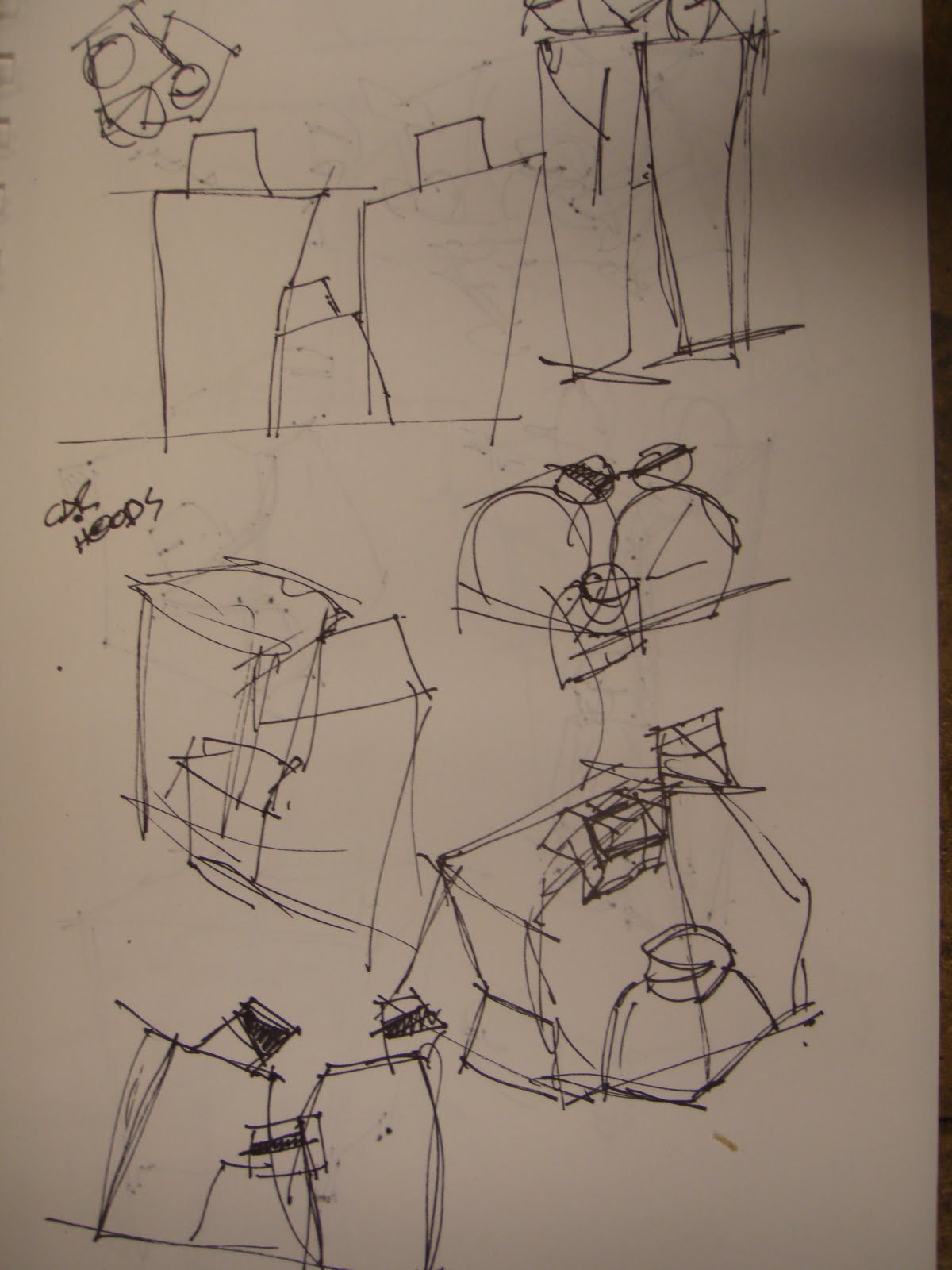
Some original sketches:


And a few models to get a feeling for the weight and three-dimensional flow.  I personally am leaning toward the tall angular one; it reminds me of the rock art in southern Utah.

Now, to figure out the final material to use.  I’d like it to repurpose something rather than use new concrete or steel or wood.


Cordell Taylor

8: The Mormon Proposition

Friday, July 23, 2010

Ammo Table, Part 2

Old ammo casings are harder to get than I first realized.  Much of the brass is re-used, which is good news for landfills but bad news for ammunition artists.  As costs have gone up, shooting ranges are more and more apt to recycle the spent casings or sell them as scrap.

I live near a large, deserted desert where people like to shoot things.  There’s probably millions of ammo casings all over the sagebrush, but fighting the rattlesnakes and 120 degree heat will have to wait until I become really desperate.

This would be a good time to mention that I don’t have much experience with guns, or shooting them, or really anything about them except that when a loaded one shows up in Act 1 it needs to get fired in Act 3.

I enjoy that a simple mechanism can be so controversial among thoughtful, considerate, and generally educated people.  Cell phones, for example,  have a much more complicated technological infrastructure and design, yet they don’t evoke nearly the emotional response that guns do.  Forget presidential debates -- lets hear Yoko Ono and Charlton Heston verbally duke it out on gun control with Larry King moderating.  What a ripe area for discussion.

There are a few artists out there who work with modern weapons as a medium, and very few who make furniture from them.  I recently ran across this lamp in Copenhagen, although I think the trigger should have been wired to turn it on and off:


Also see:


http://alfarrow.com/reliquaries/

http://sashaconstable.co.uk/projects/peace-art

http://weburbanist.com/2009/01/05/20-artworks-of-war-bizarre-gun-and-bullet-art/